The Halloween Franchise
Halloween (1978) Dir: John Carpenter $320k Box Office: $60m Worldwide, $47m US
Halloween II (1981) Dir: Rick Rosenthal $2.5m Box Office: $25m Worldwide, $20m US
Halloween III: Season of the Witch (1982) Dir: Tommy Lee Wallace $2.5m Box Office: $12m US
Halloween 4: The Return of Michael Myers (1988) Dir: Dwight H. Little $5m Box Office: $17m US
Halloween 5: The Revenge of Michael Myers (1989) Dir: Dominique Othenin-Girard $5m Box Office: $11m US
Halloween: The Curse of Michael Myers (1995) Dir: Joe Chappelle $5m Box Office: $15m US
Halloween H20: 20 Years Later (1998) Dir: Steve Miner $17m Box Office: $55m US
Halloween: Resurrection (2002) Dir: Rick Rosenthal $15m Box Office: $37m Worldwide, $30m US
Halloween (2007) Dir: Rob Zombie $15m Box Office: $80m Worldwide, $58m US
Halloween II (2009) Dir: Rob Zombie $15m Box Office: $33m US
The franchise has consistently remained low budget in US terms, although the budget for each film has mostly increased as the series progresses. This is largely due to the guaranteed high box office figures, as people come to know what to expect from the franchise; as a result almost every film has made a profit.
There has been longer gaps between later films in the series, 'Halloween H20' was made as if the previous four films had not been made and therefore links more directly to the first two films, which could be viewed as one long film, the first leading directly into the second.
The latest pair of films are remakes of the original 'Halloween' and a sequel, and are therefore completely out of continuity with the rest of the franchise. Both of these recent films have performed fairly well at the box office. Trends among remakes are increased levels of gore and sexual explicitness.
The original 'Halloween' is often regarded as one of the most influential in the slasher genre, as well as being one of the earliest films in it. Notably it has an extremely small budget and an almost unknown cast (with the notable exception of Donald Sutherland). In terms of the genre, it was one of the first films, if not the first, to present the killer as an indestructible 'other', as opposed to a human menace. This theme has continued in subsequent, more fantasy orientated slasher films.
Specifically, the killer in the franchise, Michael Myers, is introduced as killing his sister as a little boy, and remaining in a mental institute for the next decade or so. This makes him fairly unique as a slasher film killer, having no real motive for carrying out his attacks.
Friday, 18 January 2013

Thursday, 17 January 2013
History of the Slasher Genre
Our group has written and prepared the above vodcast; a brief history of the slasher genre from it's earliest beginnings to the present day.
Friday, 11 January 2013
Some possible distributors for our film
Top 10 film distributing companies in the US, from 1995 to 2012:
Warner Bros.
Walt Disney Pictures
Sony Pictures
Paramount Pictures
20th Century Fox
Universal
New Line
Dreamworks SKG
Miramax
MGM
(Source: The-Numbers)
Most successful distributors in the UK, top 10 films 2012:
Sony
20th Century Fox
Warner Bros.
Universal
Walt Disney
eOne
Paramount
Lionsgate
Momentum
Entertainment Film Distributors
(Source: James Bond News)
Low budget and indie film distributors in the UK:
Optimum Releasing
Optimum Home Entertainment (DVD & Blu-ray)
Warner Bros.
Walt Disney Pictures
Sony Pictures
Paramount Pictures
20th Century Fox
Universal
New Line
Dreamworks SKG
Miramax
MGM
(Source: The-Numbers)
Most successful distributors in the UK, top 10 films 2012:
Sony
20th Century Fox
Warner Bros.
Universal
Walt Disney
eOne
Paramount
Lionsgate
Momentum
Entertainment Film Distributors
(Source: James Bond News)
Low budget and indie film distributors in the UK:
Optimum Releasing
Optimum Home Entertainment (DVD & Blu-ray)
My definition of distribution
Distribution is the release and sustainment of films in the market place. It is 'selling' the product.
BFI: Film distribtion
Wikipedia: Film distribtion
Raindance: Film distribution
AS Coursework: Film distribution
Launching Films: Film distribution
BFI: Film distribtion
Wikipedia: Film distribtion
Raindance: Film distribution
AS Coursework: Film distribution
Launching Films: Film distribution
Monday, 7 January 2013
SlasherEG3: Cry_Wolf
Cry_Wolf
(2005) Jeff Wadlow
PRODUCED BY: Rogue Pictures, Hypnotic
DISTRIBUTED BY: Rogue Pictures, Universal Pictures (US) (full list)
BUDGET: $1m
BOX OFFICE: $10m US, $15.5m Worldwide
RATINGS: IMDB 5.7
MY RATING:
WIKI, OFFICIAL SITE
 The only ident is that for Rogue Pictures, the main production company. We hear the sound of panicked, heavy breathing before are aware of what we are seeing; a chase sequence has already begun.
 The opening is almost pitch black, the only light being a torch held by the persuer. This is an effective technique, as it suggests the location of the stalker, but hides their identity.
 We get brief CU shots of the fleeing girl; she fulfills the female stereotype of being scared and ineffective against her stalker. She is also blonde, another feature that connotes being a helpless victim.
 At this point in the sequence, there is no soundtrack, all sound is diagetic. We rely totally on the fast-paced editing and other sound effects such as the crunch of leaves underfoot to build up the tense atmosphere.
 We cannot make out everything within the frame, as the girl effectively blends with her background, and we haven't seen the stalker at all so far. This use of narrative enigma is a key factor in keeping the viewers hooked.
 The camera has remained quite close to the girl for the first part of the scene; this proximity causes the audience to fix on this character as their viewpoint.
 Now the shot changes, seemingly to a POV shot of the stalker, casting his light across the ground. This acts as a shift in which character becomes our viewpoint.
 The stalker moving across shot reveals that we are actually standing a little behind the character, not seeing through their eyes as we first thought.
 The girl in her hiding place remains unseen as she searches for something.
 Her mobile phone provides the only source of light in this scene, and as movement has stopped it is almost entirely silent. When the phone rings, the sudden noise shocks us, and also acts as a cue for the music to build to a crescendo.
 In this final shot, we get a very brief look at the stalker who appears to be wearing dark clothing. They are also carrying a gun as their weapon, which is unusual in itself as the typical slasher uses a knife or some other such bladed object.
 The shot from the gun turns the screen white, with some pale pink or red colouring that has obvious connotations of blood, making it clear what has happened. The white screen is also an effective transition into the next sequence and the opening titles.
(2005) Jeff Wadlow
PRODUCED BY: Rogue Pictures, Hypnotic
DISTRIBUTED BY: Rogue Pictures, Universal Pictures (US) (full list)
BUDGET: $1m
BOX OFFICE: $10m US, $15.5m Worldwide
RATINGS: IMDB 5.7
MY RATING:
WIKI, OFFICIAL SITE


Tuesday, 18 December 2012
SlasherEG2: Halloween
Halloween
(1978) John Carpenter
PRODUCED BY: Compass International Pictures, Falcon International Productions
DISTRIBUTED BY: Compass International Pictures, Mid-America Releasing (US), Miracle Films (UK) (full list)
BUDGET: $320k
BOX OFFICE: $47m US, $60m Worldwide
RATINGS: IMDB 7.9
MY RATING:
WIKI, OFFICIAL SITE
 After the opening title sequence, which, with its quick and unsettling pace, sets up the tone of the film, we fade straight in to simple white text on a black background. The font and use of captioning closely mimics that of 'Psycho', which was a key influence on director John Carpenter's work.
 Exposition is provided, with the exact date, time and location appearing on screen. Given that the next sequence is almost entirely dialogue free, it's possible that these were added to avoid confusing the audience.
 The use of a long camera shot and a low angle makes the house seem large and imposing, especially as its surroundings are completely devoid of any light - so the viewers eyes are naturally drawn to it.
 Shaky, hand-held camera work signifies a point-of-view shot, that we are looking through the eyes of an unseen character.
 The carved pumpking acts as a form of continuity with the opening sequence, as well as the more obvious connotations with Halloween itself.
 We have a typical teenage couple

 The light being switched out in the bedroom marks the first appearance of non-diagetic sound in the opening, and acts as a signifier to the audience. Up to this point, the film has been in a state of equilibrium, the change in the score coupled with the slight dutch angle here suggests this is about to change.

 The camera moves through the house, and we are given hints as to the identity of the character whose POV we are seeing. We look at the sofa where the couple were earlier, suggesting that they are the target.
 Our character is cautious to approach the boyfriend, who leaves the house. A comment on gender roles; males are typically seen as tougher than females and more likely to put up a fight in response, which could explain why he isn't targeted.

 The selection of the mask has the immediate effect of creating claustraphobia for the audience, as we see even less of the surrounding area with it on. The mask is also a call forward to later in the film when an adult Michael wears another Halloween mask.
 We get a brief look at the half-naked girl, suggesting vulnerability and weakness. The POV shot looks over at the recently vacated bed; connotations are that the about to be committed murder is related to sexual activity.
 The murder itself is mostly inferred rather than show, screams from the girl, sound effects and the score reaching a crescendo provide most of the scenes tension and horror; the quickly moving POV and a final shot of the girl's blood covered body confirm what we have half-seen.


 The reveal of the killer is a shock for the audience, although the low camera angles throughout the opening have hinted at it.
 The panning out of the camera to a similar shot as the one that opened the film, takes the opening full circle and effectively brings it to a close.
(1978) John Carpenter
PRODUCED BY: Compass International Pictures, Falcon International Productions
DISTRIBUTED BY: Compass International Pictures, Mid-America Releasing (US), Miracle Films (UK) (full list)
BUDGET: $320k
BOX OFFICE: $47m US, $60m Worldwide
RATINGS: IMDB 7.9
MY RATING:
WIKI, OFFICIAL SITE
 After the opening title sequence, which, with its quick and unsettling pace, sets up the tone of the film, we fade straight in to simple white text on a black background. The font and use of captioning closely mimics that of 'Psycho', which was a key influence on director John Carpenter's work.
 Exposition is provided, with the exact date, time and location appearing on screen. Given that the next sequence is almost entirely dialogue free, it's possible that these were added to avoid confusing the audience.
 The use of a long camera shot and a low angle makes the house seem large and imposing, especially as its surroundings are completely devoid of any light - so the viewers eyes are naturally drawn to it.
 Shaky, hand-held camera work signifies a point-of-view shot, that we are looking through the eyes of an unseen character.
 The carved pumpking acts as a form of continuity with the opening sequence, as well as the more obvious connotations with Halloween itself.
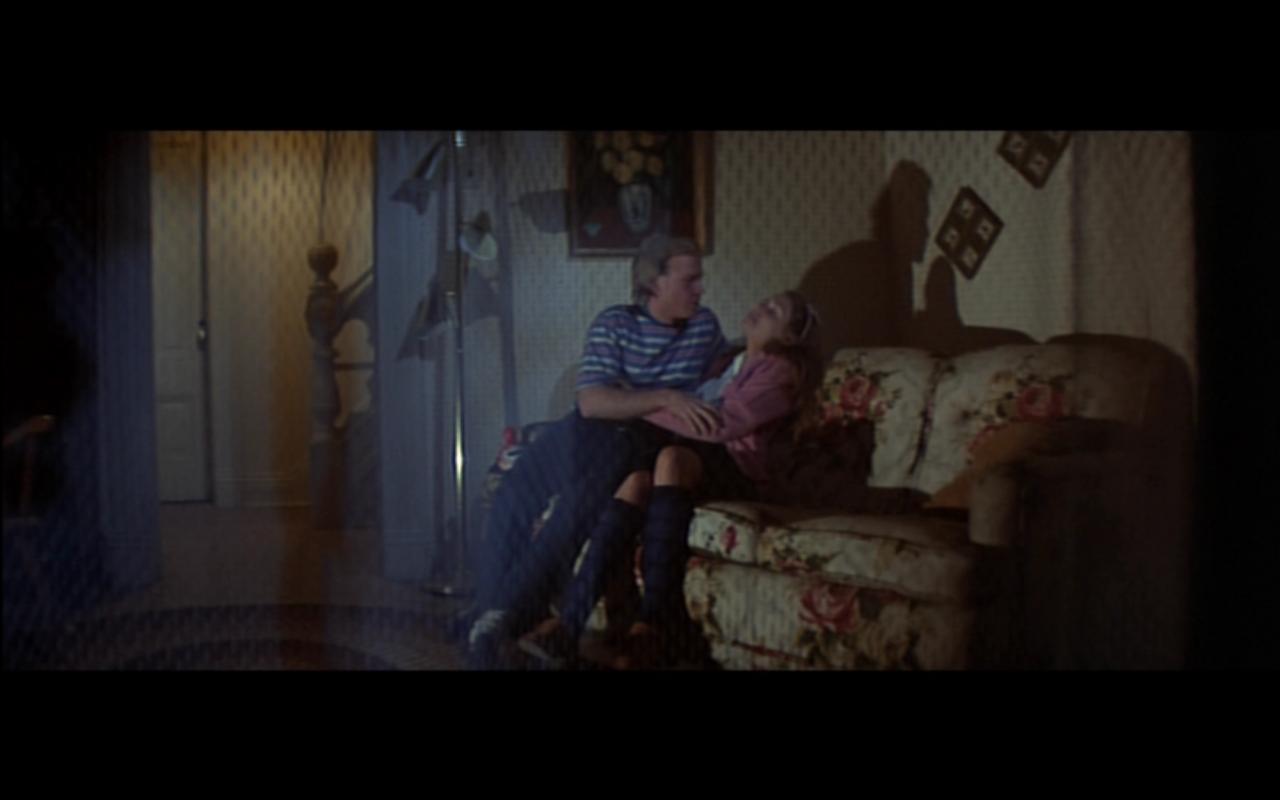 We have a typical teenage couple

 The light being switched out in the bedroom marks the first appearance of non-diagetic sound in the opening, and acts as a signifier to the audience. Up to this point, the film has been in a state of equilibrium, the change in the score coupled with the slight dutch angle here suggests this is about to change.

 The camera moves through the house, and we are given hints as to the identity of the character whose POV we are seeing. We look at the sofa where the couple were earlier, suggesting that they are the target.
 Our character is cautious to approach the boyfriend, who leaves the house. A comment on gender roles; males are typically seen as tougher than females and more likely to put up a fight in response, which could explain why he isn't targeted.

 The selection of the mask has the immediate effect of creating claustraphobia for the audience, as we see even less of the surrounding area with it on. The mask is also a call forward to later in the film when an adult Michael wears another Halloween mask.
 We get a brief look at the half-naked girl, suggesting vulnerability and weakness. The POV shot looks over at the recently vacated bed; connotations are that the about to be committed murder is related to sexual activity.
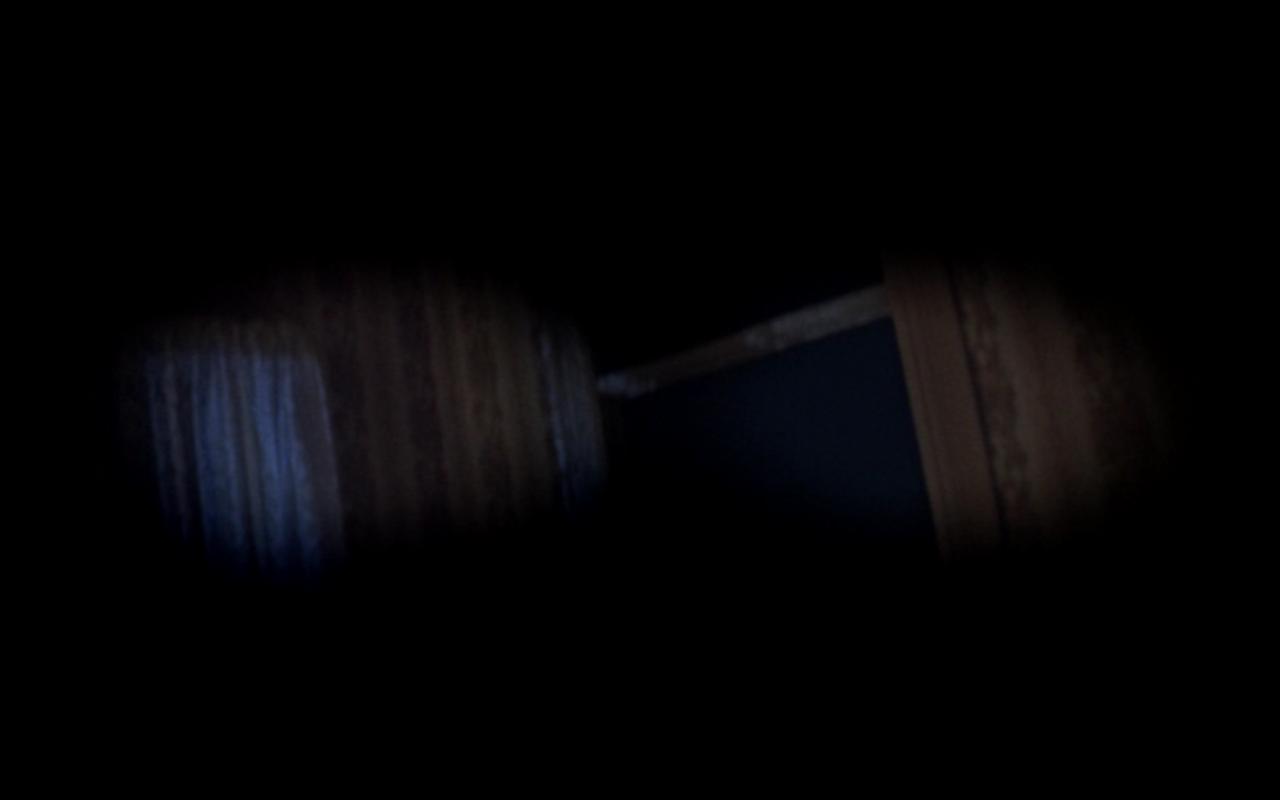 The murder itself is mostly inferred rather than show, screams from the girl, sound effects and the score reaching a crescendo provide most of the scenes tension and horror; the quickly moving POV and a final shot of the girl's blood covered body confirm what we have half-seen.


 The reveal of the killer is a shock for the audience, although the low camera angles throughout the opening have hinted at it.
 The panning out of the camera to a similar shot as the one that opened the film, takes the opening full circle and effectively brings it to a close.
SlasherEG1: Psycho
Psycho
(1960) Alfred Hitchcock
PRODUCED BY: Shamley Productions
DISTRIBUTED BY: Paramount Pictures (full list)
BUDGET: $800k
BOX OFFICE: $32m US, $50m Worldwide
RATINGS: IMDB 8.6
MY RATING:
WIKI, OFFICIAL SITE
 The slow panning sequence is of complete contrast to the fast paced, almost maniacle titles. Exposition is provided in the form of captions.
 The camera takes in the vast expanse of the city; but a gentle zoom suggests that it is searching for something.
 The change in captions each signal a shot change; the opening isn't actually one sequence. However, the presence of the same titles acts as a visual bridge that links each successive shot together in the audience's mind and makes the changes harder to spot.
 There are feelings of voyeurism as we spy on a couple getting dressed in a hotel room. Plenty of exposition comes from the exchange of dialogue between them, and we learn about their relationship.
 The very sedate, romantic opening is completely at odds with the ideas we have collected about the film; that it's a thriller featuring a psychopathic killer. In a sense, the entire opening acts as a red herring and throws us off the scent, although there are a few hints to later developments.

 Dialogue reveals that they are both living unfulfilled lives; unable to get the jobs they want and owing money to other people. This desperate attitude sets the events of the film in motion.
 Throughout the scene the emphasis is on Marion; the camera framing her in the foreground with far more close up shots. Sam is off-centre in nearly every shot, and as a result feels more distant in the mind of the audience.

 Again, although this shot is of Sam, he is off-centre and facing away from the camera, staring over the city below. The window has many connotations, including escape, hope and desire.

Subscribe to:
Posts (Atom)